
6 Common Places That Commas Are Misplaced
- Christina Crosland

- Apr 21
- 8 min read
Have you made these comma mistakes? Find out where commas don’t go and why.

The Short Story
Following the Chicago Manual of Style (CMOS), commas should not be used in the following places:
Before or in Place of That (CMOS 5.212)
Helpful jingle: That comma doesn’t go with that!
Before and After Restrictive Appositives (CMOS 6.30)
Helpful jingle: I’m positive—no commas with restrictive appositives.
After Oh in an Exclamatory Phrase (CMOS 6.38)
Helpful jingle: Oh momma, don’t add an extra comma!
Between the Verb Be and Quotes (CMOS 12.15)
Helpful jingle: Quotes with be: “No comma for me!”
Before No When It’s Not Dialogue (CMOS 12.47)
Helpful jingle: The comma says no without a convo.
Before Too (CMOS 6.56)
Helpful jingle: You too don’t need a comma before too.
Read each rule’s section below for detailed explanations and examples.
The Novel
Commas are so versatile in the English language that it seems like they can go just about anywhere. They break up complicated sentences and keep long strings of words interesting. Without commas, the rhythm of speech would largely be lost.
Because of their flexibility, commas can feel like a writer’s best friend—always there when you need them. But there are six specific places where commas don't need to be.
But before you read where those are, you may need to read a few other grammar tips to learn what subjects are (“Subjects and Objects”), what phrases and clauses are (“Phrases and Clauses”) and what restrictive and nonrestrictive mean (discussed in CMOS 6.29).
If you already know all those terms, you’re ready to read on. Here are the six common places where you might be tempted to put a comma, but CMOS specifically says not to. See if any of them stand out to you.
NOTE: CMOS is the standard style guide for US publishing. If you are following a different style guide, double-check it for these rules.
Before or in Place of That
Commas Before That
That is never preceded by a comma because that never begins a nonrestrictive, or nonessential, clause. Instead, that begins restrictive clauses crucial to identifying a noun or completing the verb in a sentence. Here’s a little jingle to help you remember this rule: That comma doesn’t go with that!
He is the best roofer that anyone could ask for.
I cannot believe that everyone hiked up that mountain.
Notice that neither of the examples above uses commas with that.
This comma rule applies to any conjunction that introduces a restrictive clause, not just the conjunction that. Other conjunctions could be who, whom, whose, and when. Nonrestrictive clauses often start with which, who, whom, or whose. But be careful, because while which used to be limited to nonrestrictive, it is now commonly used for restrictive too.
Nonrestrictive: The book I like best is Where the Red Fern Grows, which has a torn cover.
Restrictive: The book I like best is the one which has a torn cover.
Commas in Place of That
Now that we’ve established that a comma doesn’t go before that, we also need to talk about commas in place of that. You may have noticed a trend in English right now to omit that completely. Omitting that comes with its own consideration to watch out for. CMOS 5.212 says the conjunction that should not be omitted except in cases when meaning would be completely unambiguous.
If you still decide to drop that, remember that a comma does not replace it.
Correct: The teacher noticed that Emily was late.
Incorrect: The teacher noticed, Emily was late.
Correct: The teacher noticed Emily was late.
Before and After Restrictive Appositives
CMOS 6.30 explains that commas should not be used with appositives (nouns or phrases that explain another noun) when they are restrictive (essential to the sentence’s meaning). Basically, if no one would know who or what you are talking about without including the information after the noun or phrase, then don’t put commas.
The following examples of appositives show the difference between nonrestrictive (used with commas) and restrictive (used without commas).
Nonrestrictive: John’s dog, Wales, likes belly rubs.
Restrictive: John’s dog Wales likes belly rubs, unlike John’s dog Sid.
The first sentence correctly uses commas for the appositive Wales only if John has one dog. Take out the dog’s name and the sentence still talks about the same dog (because John only has one). But if John has more than one dog, leaving out the name of each dog could confuse readers, so no commas go around the appositive names Wales and Sid.
Nonrestrictive: I cannot believe that my birthday, September 16, is so common.
Restrictive: I cannot believe that the birthday September 16 is so common.
The first sentence is referring to “my” birthday, which has the appositive September 16. The date is not relevant to the sentence because this person has only one birthday. However, in the second sentence, the appositive September 16 is relevant to the sentence because otherwise, readers wouldn’t know which birthday is so common.
To recap, commas should not be used around necessary appositives, or restrictive noun or phrase. Just remember: I’m positive—no commas with restrictive appositives.
After Oh in an Exclamatory Phrase
CMOS 6.38 says commas should not come after the word oh if it is part of a multi-word exclamatory phrase. An exclamatory phrase is any phrase that expresses excitement, shock, or other emotion.
While exclamatory phrases are often paired with an exclamation point, like Gosh! or Wow!, they can also introduce a sentence if followed by a comma. Oh can be its own exclamation or part of a longer phrase. Examples of introductory exclamations that include oh are oh boy, oh dear, oh yeah, oh my, and oh geez. The comma would only come after the entire phrase.
So how do you know if oh is its own exclamation or part of a longer one? Remove it from the sentence. If what’s left still keeps the same meaning, add a comma. If removing oh changes the meaning, don’t add a comma.
Oh yeah, I forgot about that.
Yeah, I forgot about that.
Notice that the first sentence expresses remembering or surprise, while the second sentence expresses agreement or admittance. If you aren't sure if the meaning changes without the oh, put an exclamation point instead of a comma.
Oh yeah! I forgot about that. (Remembering.)
Yeah! I forgot about that. (Agreeing.)
Oh yeah, I forgot about that. (Remembering.)
Oh, yeah, I forgot about that. (Agreeing.)
These examples show that a comma between oh and yeah changes the tone and, amazingly, the entire emotion of the sentence.
Can you see now why proper placement of commas is so important?
Another tricky place to not put a comma after oh is when it is used while addressing someone, such as in “oh Lord,” “oh my angel,” or “oh gracious queen.” To remember the gist of this rule, try this memory trick: Oh momma, don’t add an extra comma!
Of course, if oh is used by itself as a one-word exclamatory phrase, it needs a comma or exclamation point after it. The same rule applies to ah. Examples include Oh, you’re right and Ah, here we are.
Here are more examples of when to use or not use commas with exclamatory phrases.
Oh, I totally forgot.
Ah, we thought you looked familiar.
Oh sheesh, everyone is gone.
Oh, just put it over here.
Ah yes, how could I forget?
Oh my heck, why is this so confusing?
Between the Verb Be and Quotes
If you commonly put a comma between be and a quote, you may do this because you know the rule in CMOS 6.43 that says quotes or dialogue are usually preceded by a comma. But that’s only true if the quote is treated as a separate statement and not as part of the sentence.
One common way quotes are introduced as part of the sentence is with a form of the verb to be (e.g., am, are, is, was) rather than a speech verb (e.g., say, reply). When the former happens, commas should not be used to introduce the quote.
Notice the difference between quoting directly (introduced by a comma before the opening quotation mark) and quoting with the verb be (no comma) in these examples:
He gave advice when he said, “Rest when you’re done.”
The advice he gave was “Rest when you’re done.”
The weather forecaster said, “Today will be rainy with a sunny disposition."
According to the weather forecaster, today will be “rainy with a sunny disposition.”
Another way a quote can be treated as part of the sentence is by introducing it with a conjunction like that. whether, or if.
The neighbor keeps saying that “the dogs won’t jump over the fence.”
He wasn’t sure if “take one for the team” meant that he was on the team.
Notice that neither of the examples above used commas to introduce the quotes. Basically, “he said” and “she said” get a comma, but any quote that is integrated into the sentence does not need a comma.
CMOS 12.15 goes into this more in depth. But to simplify, maybe you can use this silly rhyme: Quotes with be: “No comma for me!”
Before No When It’s Not Dialogue
I often question whether I need a comma before a one-word quote, such as no. If you read CMOS 12.47, the rule says no. See? No comma needed! All one-word responses such as yes, no, why, how, and maybe do not need quotation marks or an introductory comma unless they are specifically part of dialogue.
When not in dialogue:
He wrote yes on the note.
The bus driver said no to me.
The toddler wouldn’t stop asking why.
When in dialogue:
“Yes,” he answered.
The bus driver said, “No.”
The toddler asked, “Why?”
This one is pretty simple but could still use a memory trick. How about this: The comma says no without a convo.
Before Too
Not using a comma before too isn’t a widely accepted rule yet, but it’s headed that direction. CMOS 6.56 allows for no comma. However, there are still a lot of style guides that say to put a comma in front of too, so this last section is up to preference.
Arguments for no comma are that the adverbs too and either really aren’t easily misunderstood. And you wouldn’t put a comma in front of also, so why put one in front of too? Next time you are writing, consider: You too don’t need that comma after too.
Doesn’t Tim like to go skiing too?
You don’t need to pay me anything either.
I love hanging out with my friends Chrissy, Cassidy, and Lola too.
To help you remember these comma rules, I’ve created a cheat sheet you can save.
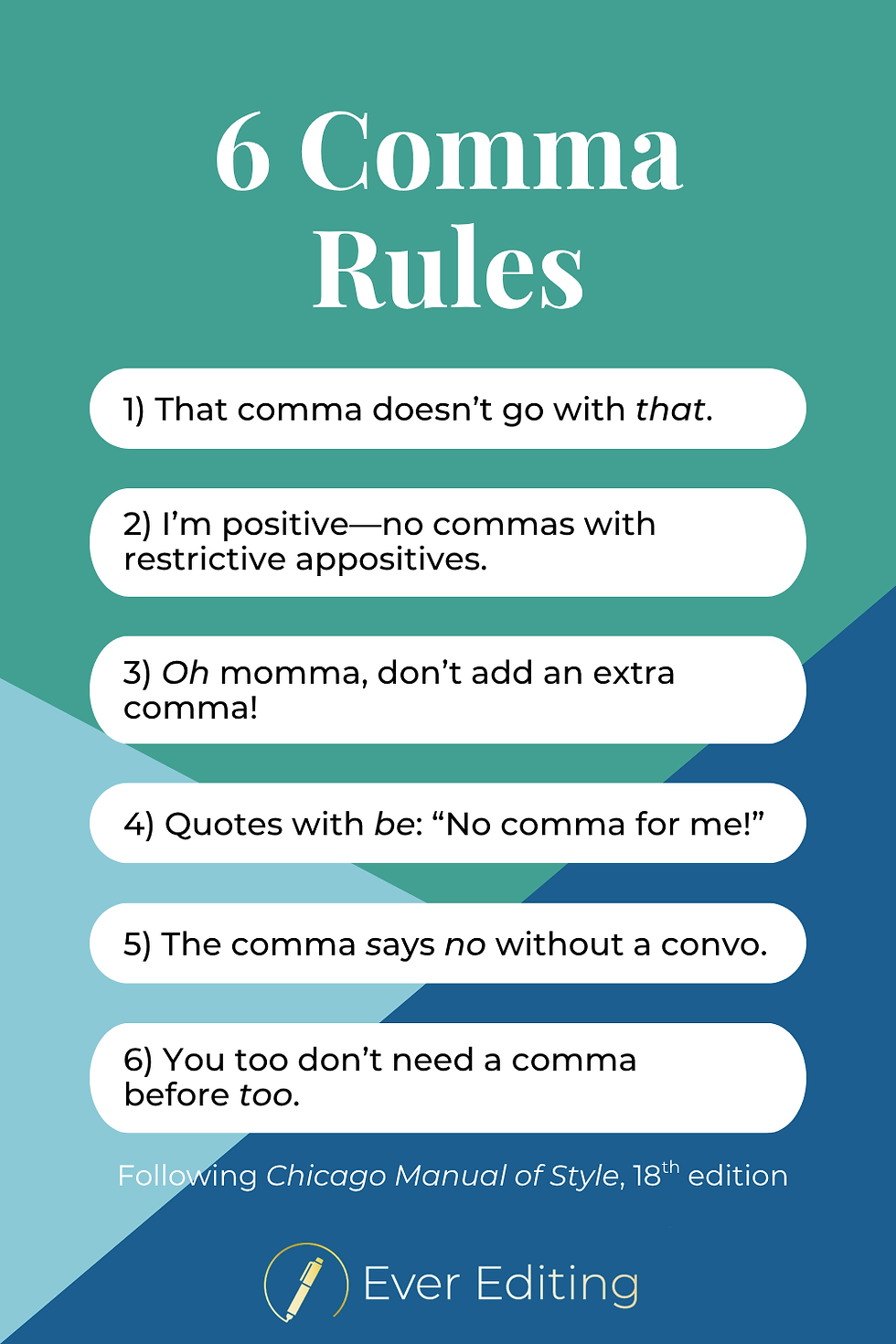
These six tricky comma mistakes catch even editors off guard sometimes, so don’t worry if you don’t remember all the rules. Just come back here whenever you’re questioning the comma that your spell check wants to add. I know I’ll be coming back to this tip myself to remember the silly little jingles!


Comments